As of 2026-07-21, Cursor published research on agent swarms and model economics (Wilson Lin, 2026-07-20). The post is a day old. I’m reacting while the frame is still fresh.
The headline for working developers is not “SQLite in Rust.” It is how agent swarms split planning and execution across model tiers — and how that choice moves cost by an order of magnitude while quality stays similar.
What agent swarms change about cost
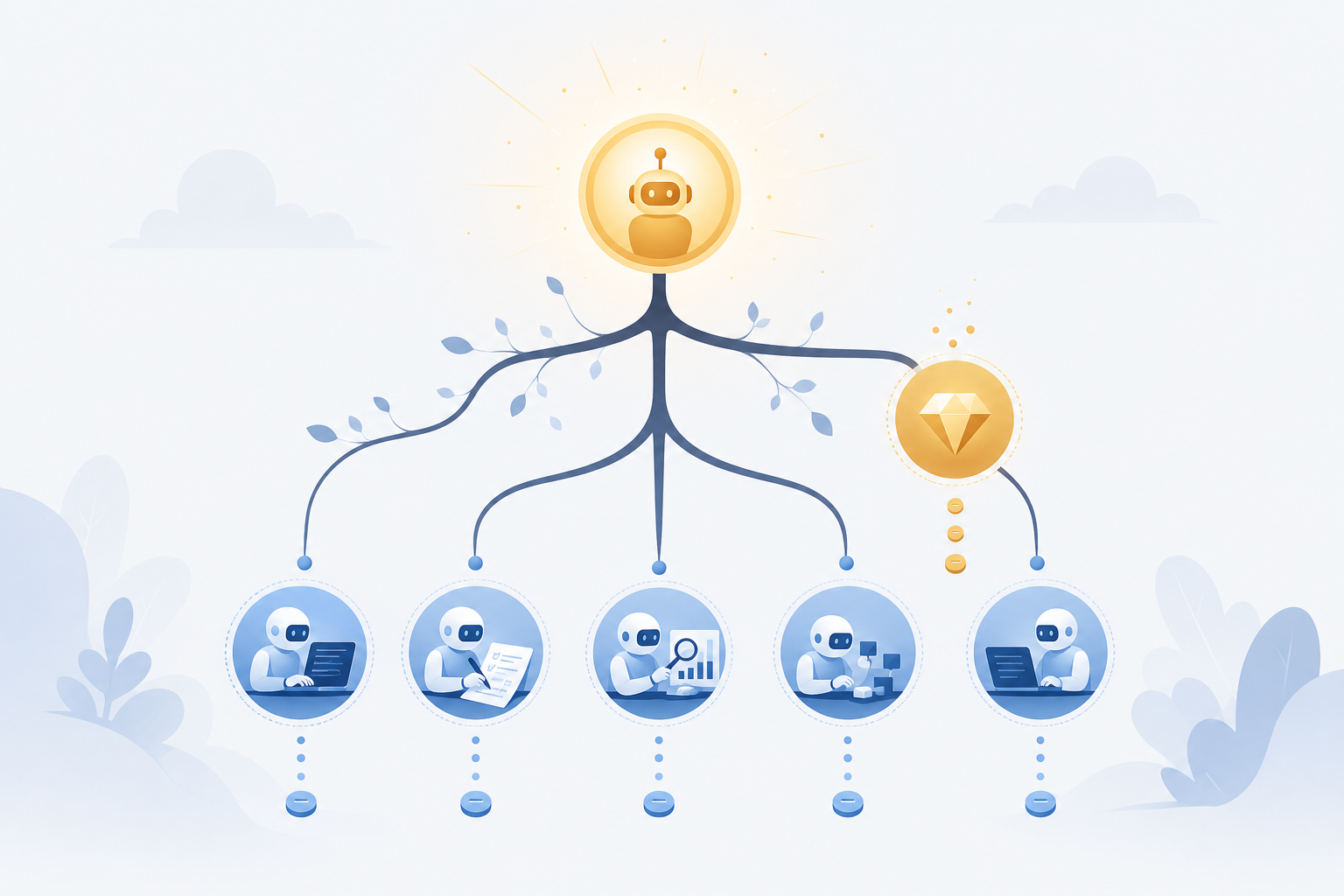
Model mix moves dollars far more than quality. Cursor’s runs put a planner on the smartest models and workers on faster, cheaper ones. The planner decomposes the goal. Workers execute the pieces.
In the cited comparison, one mix landed around $1,339 (Opus 4.8 planner + Composer 2.5 workers). Running GPT-5.5 as both planner and worker landed around $10,565. Same research setup. Wildly different bills.
Workers carry most of the tokens — at least about 69%, often over 90%. Planner tokens are fewer. They can still dominate dollars because those models are expensive.
| Mix | Role split | Reported cost |
|---|---|---|
| Opus 4.8 + Composer 2.5 | Strong planner, cheap workers | ~$1,339 |
| GPT-5.5 + GPT-5.5 | Same model for both | ~$10,565 |
| GPT-5.5 workers alone | Worker fleet cost | ~$9,373 |
| Opus + Composer workers | Worker fleet cost | ~$411 |
Those worker-side numbers make the point sharper. GPT-5.5 workers alone were about $9,373. The Opus + Composer worker fleet was about $411. Most volume is worker work. Paying frontier rates for that volume is where the bill explodes.
Cursor also argues that context efficiency matters more than parallelism alone. The planner never implements. The worker never plans. That separation keeps each agent’s context from filling with the wrong kind of detail. Parallelism helps. Routing the right work to the right model — and keeping contexts clean — is the scaling lever they emphasize.
The SQLite-from-documentation-in-Rust benchmark is orientation, not the lesson. Related earlier swarm work exists. This post is the economics and harness update. That is where I am reading.
Why this looks like my editor/writer harness
I already run a smaller, sequential version of the same shape. I do not run Cursor’s research swarm. I do not claim 1,000 commits per second or SQLite-from-scratch experiments. My harness is an editor/writer loop that rhymes with the economics.
On this blog, a stronger main agent is the editor/harness. It owns the brief, facts, gate, and publish prep. Prose goes to a writer subagent: cursor-grok-4.5-high-fast or gpt-5.6-terra-medium. The expensive model owns ambiguity and the assignment. The cheap model owns volume.
That is the same split Cursor describes for agent swarms — just quieter and sequential:
- Editor plans, checks sources, and writes the brief.
- Writer expands only the stance in the brief.
- Gate fails → I fix the brief or
config/style-guide.mdand re-delegate. - I do not let the expensive model rewrite article paragraphs after a failed gate.
Parallel writers happen only when briefs are already solid. One example: four de-hedge rewrites after style-guide v5. The default loop is still sequential — one editor, one writer, then gate.
This matches why I refuse one mega-chat that plans, drafts, and rewrites in the same thread. The planner’s context should not fill with prose pixels. Once the assignment is clear, the writer should not re-litigate the outline. That is context efficiency at blogging scale.
I wrote about the broader harness in my Cursor workflow pillar and the writing path in the AI writing pipeline. The rules that keep that loop stable are in Cursor agent rules that stick. This commentary itself went through the same editor/writer path.
Specs, briefs, and shared memory
The scarce input is the spec. Cursor uses that word for the assignment that keeps a swarm coherent. For me, the scarce input is the brief.
Swarm research and a blogging harness fail the same way when the assignment is mushy. A vague goal forces the planner to invent structure mid-flight. Workers then amplify that fog across many tokens. A sharp brief does the opposite: cheap volume stays on rails because the expensive judgment already happened upstream.
Cursor’s “Field Guide” experiment has agents curate a folder whose index.md is injected at the start. That is institutional memory for successors. I do not use their Field Guide product. Session continuity here uses wiki handoffs and an index — a tiny, human-triggered cousin of “shared context for the next agent.” Same need. Different scale.
When a gate fails, the fix is almost never “write harder.” It is:
- tighten the stance bullets
- lock approved experience so the writer cannot invent
- push recurring failures into the style guide
- re-delegate the same assignment with a better spec
That is why I treat Cursor’s post as a frame, not an invoice. Their numbers are research-run costs. Promo pools and model prices change. The useful takeaway is the routing pattern: pay for judgment where the problem is ambiguous; pay less where the work is volume under a clear assignment.
What I’m watching next
Hybrid routing is becoming default advice, and I expect that to stick. Frontier models for planning and review. Cheaper models for most tokens. Agent swarms make that advice concrete with published cost spreads, not slogans.
My sequential harness stays until briefs are strong enough to parallelize safely. Parallel writers only help when each brief already carries a clear stance, approved experience, and sources. Without that, parallelism just multiplies bad assignments.
What I want next is not a bigger swarm for its own sake. I want better specs:
- briefs that a cheap writer can pass without expensive rewrites
- handoffs that carry just enough shared memory
- gates that fail the assignment, not the prose
Cursor’s research on agent swarms gave that practice a public cost story. The frame matches how I already work. The numbers are theirs. The routing habit is mine.
Sources
- Agent Swarm Model Economics — Wilson Lin, Cursor, 2026-07-20
- Cursor workflow: personal harness
- AI writing pipeline: editor/writer
- Cursor agent rules that stick